Pietro Piffetti’s prie-dieu: expert statement for CITES purposes
A prie-dieu from a private collection, dating from the mid-18th century and published as a work by Pietro Piffetti, was the subject of an assignment aimed at confirming its period of manufacture and its characteristics. The presence of ivory, mother-of-pearl and tortoiseshell in the marquetry decoration also required the object to be documented in relation to the rules on trade in protected species.
The work compared the technical description of the piece with the available art-historical documentation, leading to an expert statement in April 2023 intended to obtain the CITES certificate for commercial purposes.
Pietro Piffetti: material analysis and art-historical verification of a prie-dieu
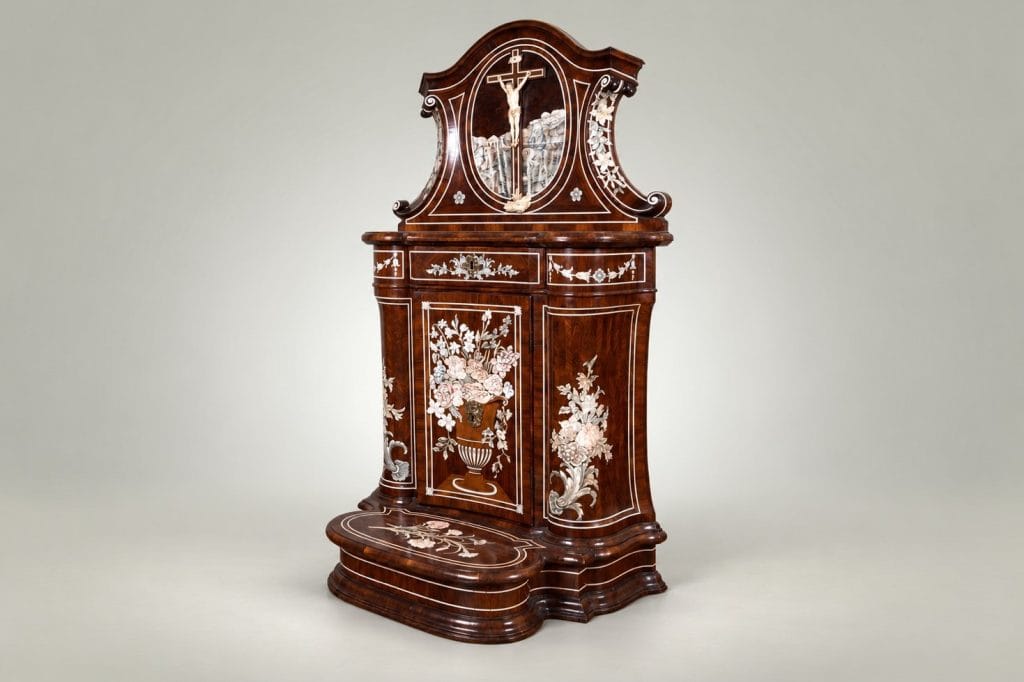
The assignment concerned a devotional piece of furniture in which different materials combine to create a complex decoration. Ivory and tortoiseshell are an integral part of the work: their use must be read together with the wooden structure, the marquetry technique and the ornamental design.
Technical analysis and description of the work
- Object: prie-dieu with upper section and Crucifix.
- Maker: Pietro Piffetti.
- Period: around the mid-18th century.
- Structure: partly poplar and partly walnut.
- Veneer: kingwood laid in a herringbone pattern and other fine woods.
- Decoration: marquetry of engraved and stained ivory, mother-of-pearl, tortoiseshell and other woods; gilt bronze ornament.
- Function: devotional furniture.
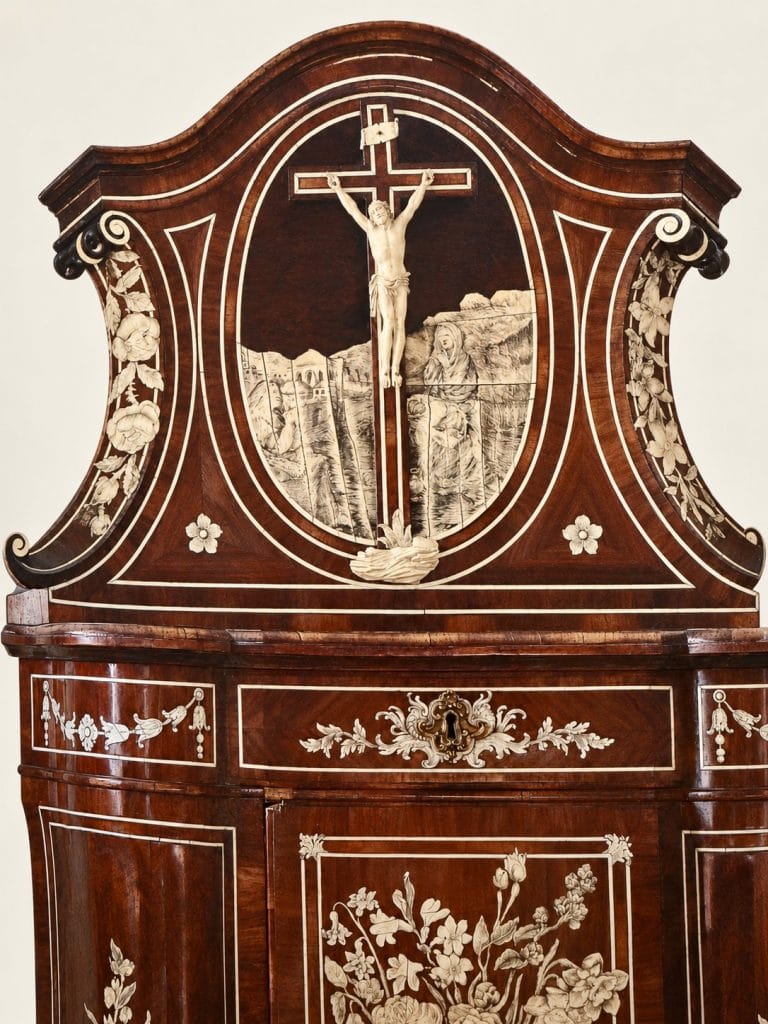
The piece has recessed sides and a shaped upper section with scrolls, with ivory outlines following its curves. The floral decoration covers the door and continues along the sides, blending with the architecture of the piece.
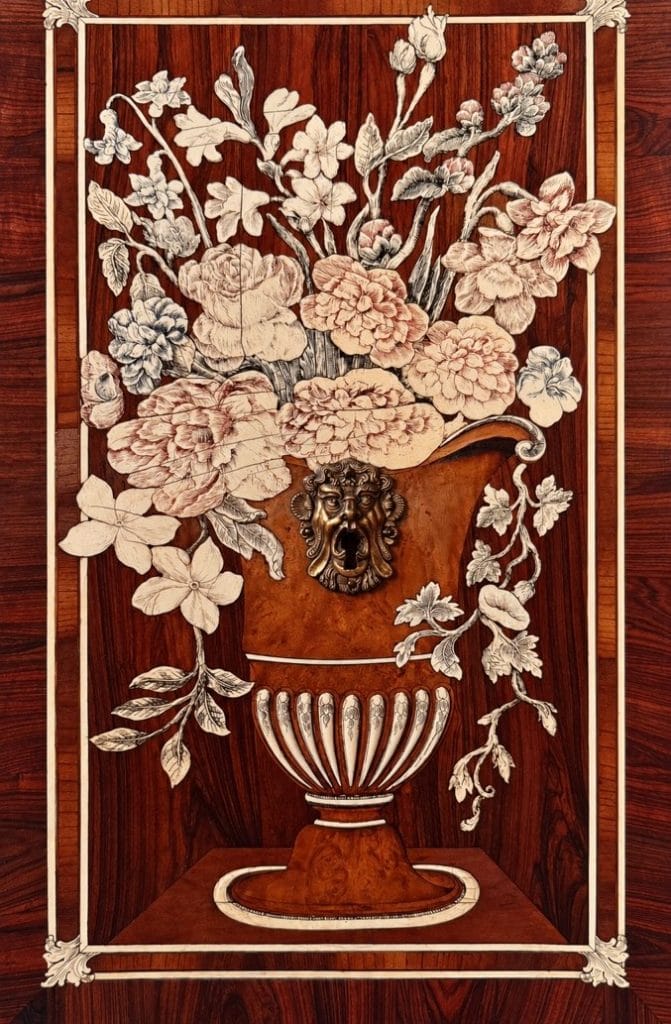
At the centre of the door is a vase full of flowers, whose imagery recalls the compositions of Flemish painting. Plant motifs rising from cornucopia-like elements spread across the sides. A gilt bronze mask serves as the escutcheon of the lock.
In the upper section, the Crucifix is applied to an inlaid scene with the figures of Mary, her sister, Mary of Clopas and Mary Magdalene, following the Gospel of John. The buildings of Jerusalem and the landscape form the background of the composition, while tortoiseshell is used to render the sky.
The contribution of bibliographic documentation
In Roberto Antonetto’s book Il mobile piemontese del Settecento (Umberto Allemandi, 2010), entry no. 56 lists the prie-dieu among the known works of Pietro Piffetti and dates it to around the mid-18th century. The photograph and description provide a definite match for identifying the work.
The text also mentions a receipt for the sale of the piece by the antiques dealer Pietro Accorsi to a private buyer in 1950. It also reports a note by Accorsi stating that it came from the House of Savoy, as a gift from Queen Margherita to one of her ladies-in-waiting.
Outcome of the assignment
On 12 April 2023 I drew up the expert statement on the prie-dieu, describing its materials, workmanship and period. The document confirms that it was made before 3 March 1947 and notes that the object already has the characteristics of a finished artefact, with no need for further cutting, working or alteration.
The outcome therefore concerns the historical and technical classification of the object for the purposes of the documentation referred to in the statement. The expert statement must be distinguished from the CITES certificate issued by the competent authority and does not, on its own, constitute a general authorisation to trade the object.
Conclusion
This assignment shows how studying a piece of antique furniture may require a combined reading of technique, materials and bibliographic sources. In the case of the prie-dieu, the description of the work and the documentary evidence made it possible to substantiate its dating and to prepare a thorough expert statement.