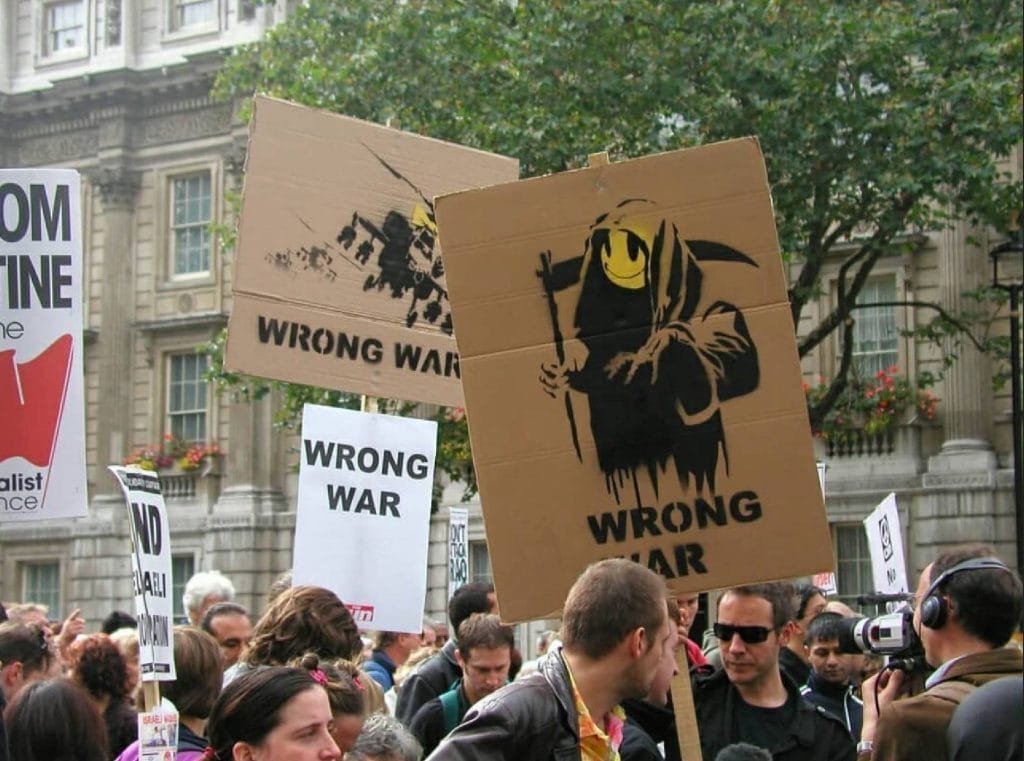
Attribution and evaluation of two placards from the protest against the war in Iraq
This case illustrates a technical-attributional appraisal and commercial evaluation of two cardboard placards related to the anti-Iraq War/Stop the War signs used in London on February 15, 2003.
The work has allowed us to build a documented framework around two ephemeral artifacts, originally conceived as protest tools and now relevant for their connection to Banksy’s early work.

The client requested an appraisal to verify the attribution and marketability of two cardboard signs depicting the subjects known as “Bomb Hugger” and “Happy Choppers / Wrong War”.
Both artifacts featured particularly interesting elements: stencil and aerosol techniques on corrugated cardboard, a sticker from the Stop the War demonstration of February 15, 2003, and, in one case, inscriptions on the back. The documentation also included a letter of provenance dated August 14, 2005, signed by the protester, describing the two signs, their use during the demonstration, and their subsequent preservation.
Technical-historical analysis
The two placards were examined as ephemeral artifacts born in a political and performative context rather than as works originally conceived for the market. This aspect required particular caution, as their attribution could not be based on an official certification from the Pest Control Office, the official body for authenticating Banksy’s works, but rather on a coherent set of material, documentary, and comparative data.
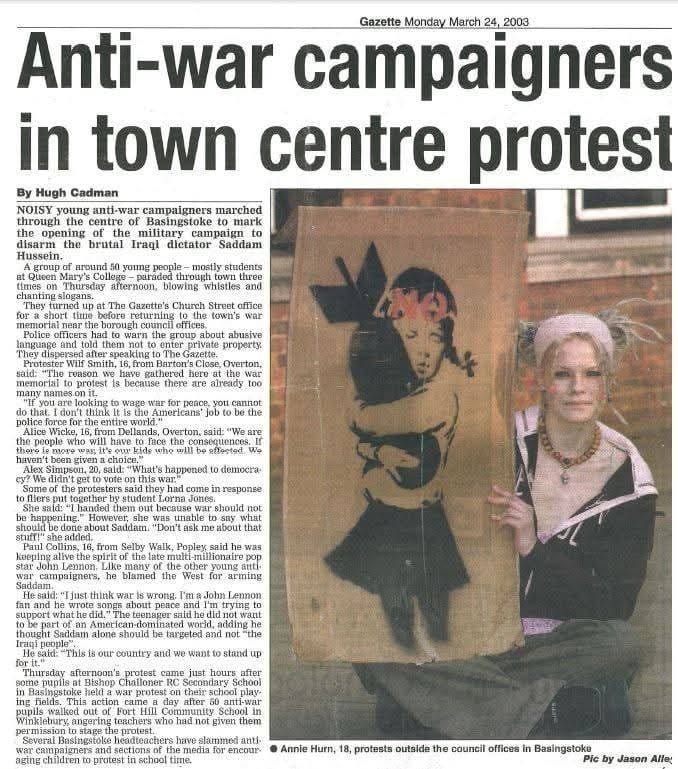
The first sign, Bomb Hugger, depicts a little girl hugging a bomb, with the word “NO” written in red. The second, Happy Choppers / Wrong War, depicts three helicopters, one with a yellow bow, accompanied by the words “WRONG WAR.” The corrugated cardboard supports, signs of use, holes compatible with attachment to a wooden handle, abrasions, creases, and stickers are consistent with use during a public demonstration.

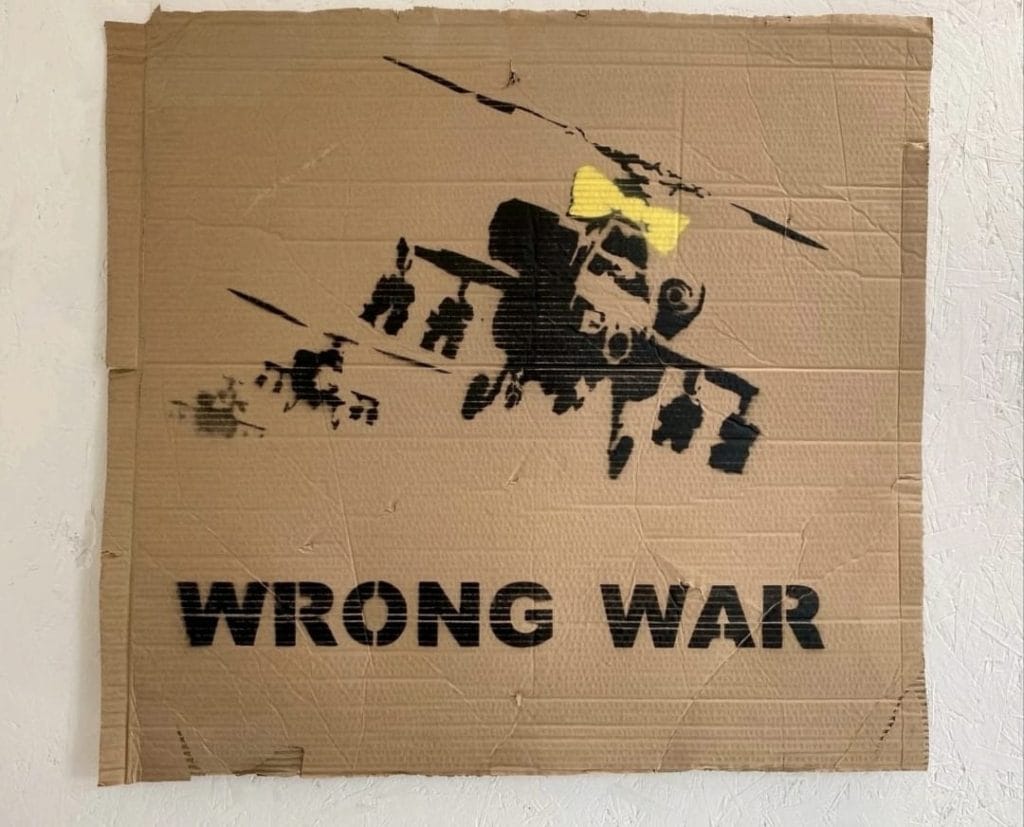
The analysis also took into account the historical context of the London protests of February 15, 2003, against the Iraq War. Comparisons with period images, press articles, previous market appearances, and dedicated exhibitions allowed us to place the two artefacts within the corpus of anti-Iraq War signs associated with Banksy’s work in the early 2000s.
Procedure performed
The intervention included the direct examination of the artefacts, the verification of the production techniques, the observation of the state of conservation and traces of use, the control of the stickers and inscriptions present on the back.
Historical-documentary research was then carried out on the placards created for the 2003 Stop the War demonstration, with an iconographic comparison with published examples and those sold on the international market.
Particular attention was paid to provenance. The Bryant letter of 2005 served as the primary source document, while the documentary appendix reconstructed the subsequent known stages, up to the shipment from the United Kingdom to Italy and the purchase by the current owner. Furthermore, for methodological accuracy, the incompletely documented point in the chain of provenance among previous owners was highlighted.
Technical data sheet
| Voice | Description |
| Object | Two anti-war placards on cardboard |
| Subjects | Bomb Hugger; Happy Choppers / Wrong War |
| Technique | Aerosol and stencil on corrugated cardboard |
| Context | Stop the War demonstration, London, 15 February 2003 |
| Measures | Bomb Hugger cm 84 x 57; Happy Choppers / Wrong War cm 74 x 82 |
| Documentary elements | Letter from the protester dated August 14, 2005; shipping and purchase documentation 2022 |
| Attribution | Attributable to Banksy’s operational context, London 2003 |
| Marketability | Conditioned, in the absence of Pest Control Office certification |
| Assessment | Indicative commercial estimate drawn up on the basis of rarity, provenance, state of conservation and market comparisons |
Conclusion
In light of the elements examined, the two placards were classified as cardboard, aerosol and stencil artefacts, London 2003, attributable to Banksy’s operational context and linked to the series of anti-Iraq War signs of 15 February 2003.
Marketability was defined as conditional, as it was based on provenance documentation, historical and material consistency, and market comparisons, but lacked Pest Control Office certification. This clarification is essential for the correct presentation of the goods on the secondary market.
The appraisal thus enabled the transformation of two ephemeral and complex objects into documented, contextualized, and appraisable assets, providing the owner with a useful technical tool for potential negotiations, presentations to specialized operators, insurance coverage, or future disposal.
The peculiarity of this case lies in the very nature of the artefacts: not works created for a gallery but signs intended to be held up during a political demonstration.
Their documentary power comes not only from the image but from their use. Holes, creases, abrasions, stickers, and inscriptions are not simply signs of wear but an integral part of the object’s history.
In this sense, the two placards represent a significant example of how an ephemeral material, created to communicate an immediate message in public spaces, can acquire historical, artistic, and collectible value over time.